Monthly Archives

October 2026

User problem first

Researchers want clean, repeatable behavioral readouts without losing hours on setup or troubleshooting, and that starts with empathy for the daily lab grind. When a study hinges on a single cohort’s sucrose preference, you need equipment that makes protocol fidelity obvious and fatigue-free; a straightforward example is a well-built sucrose preference test kit that reduces handling variability and keeps data trustworthy.

What users actually need — clear, testable goals

Think like the person running the assay. They need: simple calibration, unambiguous data outputs, minimal daily maintenance, and quick checks that confirm the system behaved across the entire test window. Usability features matter: intuitive bottle IDs, easy logs for side-preference swaps, and alerting when flow or weight sensors drift. Those choices remove guesswork so the team focuses on biology, not on whether the hardware introduced bias.

Design trade-offs that matter to labs

Every design decision shifts effort between setup, daily operation, and analysis. Manual two-bottle setups keep costs low but increase person-to-person variability. Automated systems reduce handling but add complexity and service needs. Prioritize transparency: sensor readings that map directly to the paper protocol make troubleshooting fast. Choose modular designs so a faulty sensor can be swapped without halting an entire study.

Common mistakes and how to avoid them

People underestimate habituation time, overlook side-preference controls, and forget to validate liquid delivery across temperature ranges. Calibrate sensors under the same environmental conditions used during experiments. Always run mock trials with water only, track baseline bottle preferences for several days, and log ambient factors that correlate with consumption. These steps cut false positives and keep results interpretable.

Alternatives and realistic trade-offs

Behavioral alternatives exist — progressive ratio tasks, operant chambers, or intracranial self-stimulation — but each requires different expertise and may probe distinct constructs of reward. For straightforward hedonic readouts, a two-bottle sucrose preference approach is efficient; if you need temporal precision or event-triggered recording, consider automated lickometers. Match the tool to the question, not the other way around.

Experience, authority, and a real-world anchor

Teams that design reliable behavioral equipment combine lab-side testing with production QA and iterative user feedback. Work with groups that have run protocols in NIH-funded labs in the United States and whose development cycles included side-by-side comparisons with published methods; that kind of cross-checking shows up in reduced variance and clearer replication. For labs sourcing ready-to-use animals and validated workflows, choosing equipment compatible with commonly used sucrose preference test rats helps keep methods aligned with the literature and shortens validation time.

From prototype to production — practical checkpoints

Move from prototype to production by locking down test protocols, documenting calibration steps, and running multi-site pilots. Establish spare parts lists and simple maintenance guides written for technicians. Build data export formats that plug into common analysis pipelines so the transition to scale doesn’t create new bottlenecks. Validate each production batch with acceptance tests that mirror the final experiment.

Conclusion

You want tools that respect the constraints of daily lab work and preserve the integrity of behavioral measures. A human-centered approach to designing sucrose preference systems — marrying straightforward operation, clear calibration, and production-grade reliability — produces datasets you can trust and repeat. That practical alignment is what teams find when they pair thoughtful design with suppliers experienced in behavioral workflows like those supported by BioMed Easy.


0 comments
0 FacebookTwitterPinterestEmail

Why this guide exists

You’re fighting power outages, rising demand charges, and shaky grid pricing. Those are the real problems that push C&I teams toward microgrids. Start by checking if your pain points line up with solutions like off grid energy storage systems — they fix downtime and shave peak bills when sized right. I’ve reviewed dozens of site plans and helped teams translate outages into spec sheets, so what follows comes from hands-on troubleshooting, not marketing fluff.

Core problems to pin down first

Pin the exact issue before picking tech. Ask these quick questions:

  • Are blackouts the main problem, or is it peak demand billing?
  • How long must you island—hours, days, weeks?
  • Do you need seamless transfer or manual restart?
  • Is space, weight, or noise a constraint on-site?

Answer these and you’ll stop buying shiny gear that doesn’t solve your actual problem.

Match problems to pragmatic solutions

Short outages and peak shaving: battery-dominant systems with fast controls. Long-duration resilience: batteries plus generator or hydrogen options. If scheduled outages are the issue, lean into automated controls and energy management. For true off-grid readiness at industrial scale, evaluate a complete off grid microgrid solution that bundles storage, generation, and control logic so components play well together.

Technical checks that catch failures early

Watch for these common tech pitfalls:

  • Undersized inverter or switchgear that bottlenecks capacity.
  • Poor thermal management for battery banks—shorter life, surprise replacements.
  • Weak controls integration: meters and PLCs that don’t share data cleanly.
  • Ignoring maintenance access when designing container layouts.

Make a simple site-sweep checklist before spec sign-off: cable routes, ventilation, emergency egress, and a test sequence for islanding.

Money matters: costs, incentives, and contract traps

Don’t equate low upfront price with low total cost. Compare:

  • Capex vs. leasing or energy-as-a-service models.
  • Available tax credits or accelerated depreciation for batteries and renewables.
  • Warranties that actually cover replacements and capacity fade.
  • Performance guarantees tied to measurable metrics (uptime, kW availability).

Watch out for vague O&M scopes and long lead-time clauses. Get clear SLAs for response times during faults.

Operational playbook — test before you trust

Run real drills:

  • Simulate islanding at peak load and at light load.
  • Measure transfer time and verify critical loads stay up.
  • Log state-of-charge patterns over 30 days; use that to tune dispatch logic.
  • Train staff on manual overrides and emergency shutdowns.

Document the drills. If shore power returns, confirm auto-reconnect behavior every season.

Lessons from a real disaster

Puerto Rico after Hurricane Maria showed how fragile long-distance supply can be and why local resilience matters. Sites that prioritized modular, maintainable systems recovered faster. That event pushed standards for microgrid integration and made operators demand clearer testing and spare-part strategies.

Common vendor claims to challenge

Vendors will promise “one-size-fits-all” control stacks and infinite cycle life. Ask for field data. Request references from nearby climates and similar loads. Demand test reports for system controllers and request a site-specific energy model rather than a generic brochure. Real partners share failure modes and mitigation plans, not just performance charts.

Quick decision checklist

Before you sign:

  • Can the system meet your minimum island time in real scenarios?
  • Is the O&M package clear and affordable?
  • Are warranties tied to real performance metrics?
  • Do controls and metering integrate with your plant SCADA?
  • Do you have spares and a local service plan?

If you answer “no” to any, pause and fix that gap.

Wrap-up

Solve the concrete problem first—outages, demand bills, or compliance—then pick tech that’s proven for that use-case. Avoid one-off components that create operational debt. For teams that want practical design and procurement help rooted in site realities, working with partners who map specs to real constraints, like WidenEdge, keeps projects focused on outcomes rather than vendor promises.

0 comments
0 FacebookTwitterPinterestEmail

Why compare platforms for silver index CFDs

Choosing where to trade silver via an index cfd is not just about platform polish; it affects execution, cost, and risk management. My approach here is cautious and evidence-based: I weigh spreads, execution speed, and liquidity data against typical user needs. Historical moves—such as the sharp price swings on COMEX around 2011—show how quickly margin requirements and slippage can reshape outcomes for traders focused on precious metal indices.

Head-to-head: execution, cost, and risk features

Compare three practical dimensions when assessing brokers for silver CFD indices: spread and commission structure, available leverage and margin rules, and execution quality (including slippage). Spread directly alters break-even thresholds; leverage and margin determine capital efficiency and risk intensity; execution quality determines whether a theoretical edge survives live markets. Against major alternatives, GTCFX presents transparent spreads and range-tuned liquidity pools that are verifiable on live ticks. This reduces execution uncertainty for traders who aim to use tight risk controls and hedging strategies.

Client tools and workflow differences

Platforms differ in order types, charting, and API access. Some emphasize algorithmic hooks; others prioritize mobile simplicity. For index-focused silver strategies you likely need reliable stop placement, depth-of-market visibility, and consistent time-in-force options. GTCFX supports advanced order types and clear margin reporting, which helps professionals keep control over leveraged positions. Operationally, that translates into fewer surprise margin calls and steadier strategy backtests when you normalize for spread and slippage.

Common mistakes traders make—and how comparative insight helps

Traders often underprice the impact of spread widening during events, neglect realistic slippage in backtests, or overuse leverage without contingency planning. These are avoidable. Perform scenario checks: stress-test a 2–5% silver shock, then review margin buffers under that scenario. Also compare historical execution data across platforms during busy sessions. Small differences in liquidity can compound quickly—so choose a provider whose live trading statistics align with your model assumptions. —A short caveat: models lie if inputs are optimistic.

Practical setup checklist before you trade

Use this concise checklist to align platform selection with your strategy. 1) Confirm historical average spread for the silver index product during market hours you trade. 2) Verify margin schedules and leverage caps applicable to your account tier. 3) Request sample execution reports or demo logs showing slippage during high-volatility days. 4) Ensure the broker supports your risk tools: trailing stops, limit-if-touched, and position-level reporting. Clear answers on these points separate well-integrated platforms from marketing claims.

Three golden rules for selecting the right index CFD provider

1) Prioritize measurable execution quality: insist on recent tick-level sample data and check realized spread percentiles, not just headline spreads. 2) Match margin and leverage to workflow: higher leverage can be counterproductive if your platform widens spreads under stress. 3) Demand transparent liquidity disclosure: partners who publish aggregated depth and fill rates reduce model risk. These metrics are practical and comparable across providers; treat them as your decision core.

Choosing a platform that aligns with those rules makes the difference between predictable outcomes and repeated surprises. Many professional index traders find that transparent reporting and consistent fills are worth a modest cost premium. For index-centered silver strategies, that alignment is precisely where GTCFX can sit within a robust operational plan—providing the execution clarity and risk controls experienced traders rely on. —Final thought: keep your edge simple.

0 comments
0 FacebookTwitterPinterestEmail

Comparative thesis and scope

When you need to choose equipment for behavioral assays, treat the decision like a systems architecture trade-off: throughput vs fidelity, closed-loop control vs manual oversight, and support footprint vs integration API. I’ll compare common platform classes—turnkey boxes, modular rigs, open-hardware builds—against practical metrics. If your project includes conditioned-avoidance paradigms or place-preference paradigms, you’ll want to benchmark candidates using a representative assay such as a shuttle box test to reveal performance differences under load.

Key metrics that drive useful comparisons

Measure these objective signals rather than vendor fluff: temporal resolution (ms-level latency, jitter), sensor fidelity (photobeam vs IR arrays vs video tracking), control determinism (hardware interrupts vs polling), calibration repeatability, data integrity (lossless timestamps, checksum), maintenance MTTR, and software lifecycle (patch cadence, versioned APIs). Quantify each metric with a test harness and an SLA: e.g., mean latency ≤10 ms and CV <5% for stimulus onset across 1000 trials.

Platform classes and where they fit

Turnkey systems: high polish, vendor QA, integrated analytics; they minimize setup risk but often lock you into vendor firmware and data formats. Modular rigs: mix-and-match sensors and actuators, good for labs that iterate protocols; potential integration debt if drivers aren’t standardized. Open-hardware builds: cheap and flexible, but expect bespoke calibration work and sparse support. Automated behavioral suites (commercial automated avoidance/conditioning rigs) deliver throughput and repeatability for series studies but require verification that the control loop and data pipeline meet your latency and audit requirements.

Practical evaluation workflow

Run a staged test: baseline validation, stress test, long-run drift. Baseline validation verifies specs under ideal conditions (single animal, fresh calibration). Stress test simulates operational load—batch runs, multi-cage arrays, simultaneous I/O—to catch race conditions and network bottlenecks. Long-run drift looks at calibration stability and maintenance cadence across weeks. Capture raw telemetry and compare both statistical metrics and failure modes. Automate the tests where possible and treat failure logs as first-class artifacts for vendor conversations.

EEAT: practitioner experience, standards, and a real-world anchor

From field experience auditing behavioral rigs for academic and preclinical teams, the highest-risk failure modes are silent: timestamp drift, unreported missed events, and opaque data exports. Follow ARRIVE guidance and GLP-adjacent QA where applicable. For real-world anchoring, note that NIH-funded inhibitory avoidance research at Johns Hopkins has repeatedly highlighted reproducibility concerns tied to stimulus timing and platform variability, which is discussed in peer-reviewed protocols and institutional reports. Validate system behavior against established paradigms such as the inhibitory avoidance test and document the exact firmware/software versions, calibration steps, and environmental conditions used in each benchmark run.

Common pitfalls and practical fixes

Pitfall: trusting vendor demo data. Fix: run your own runs with your protocol and instrumentation. Pitfall: neglecting timebase synchronization across devices. Fix: implement PTP/NTP where possible and verify with loopback timestamp checks. Pitfall: assuming software updates are backward-compatible. Fix: maintain a staging image and test critical pipelines before deployment. Pitfall: relying solely on visual inspection for sensor health. Fix: schedule automated sensor validation with known stimuli and log the results.

Alternatives and trade-offs you should weigh

If you need fast deployment and conservative risk, pick a validated commercial automated suite. If you expect iterative protocol changes and want full-stack control, choose modular or open-hardware but allocate headcount for validation and calibration automation. For large cohorts where throughput matters more than per-trial nuance, horizontal scale with identical, factory-calibrated units. For mechanistic neuroscience questions where microsecond timing matters, prioritize deterministic control loops and hardware timestamping even if that increases cost.

Synthesis and practical outcome

Comparative evaluation reduces procurement risk: measure latency, jitter, and reproducibility under your exact protocol, stress test at scale, and log failures as you would for software incidents. Document your validation artifacts, align to ARRIVE/GLP practices, and choose platforms where calibration and data export are transparent. When you need reliable, validated systems and clear traceability for behavioral assays, consider suppliers whose products and documentation let you reproduce benchmarks and audits—such operational clarity is the core capability that BioMed Easy consistently surfaces in its product and protocol materials.

0 comments
0 FacebookTwitterPinterestEmail

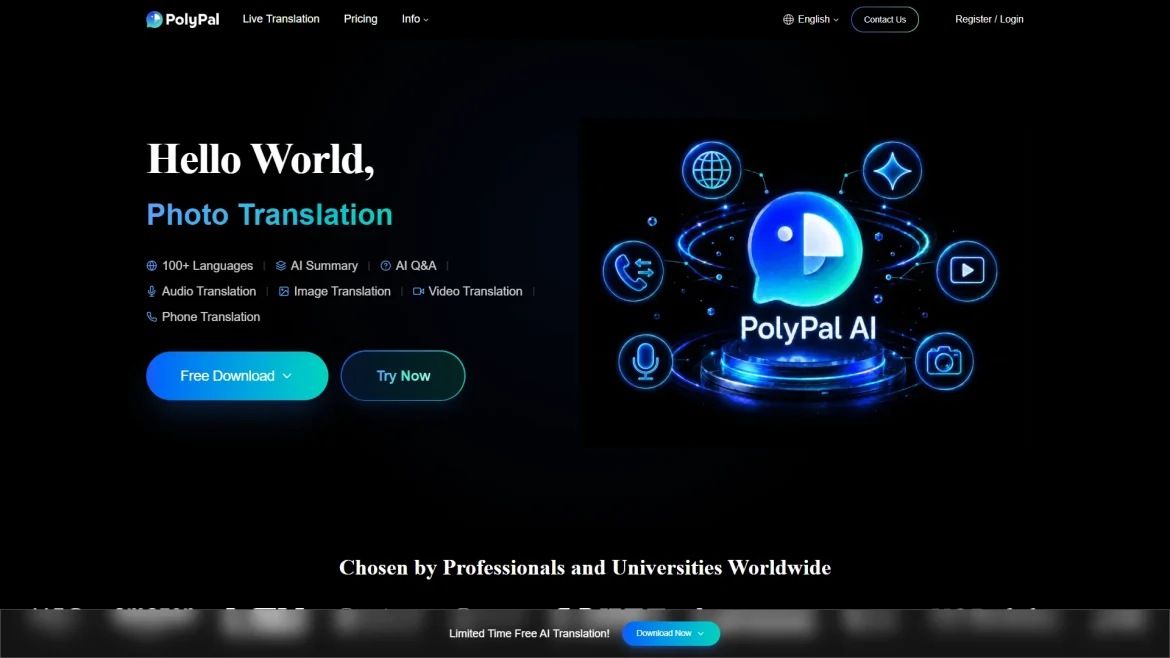
best 4 real-time translation tool 2026

The Hook

Real-time translation tools can reduce language barriers in meetings, travel, events, study, and everyday conversation, but choosing the best option is difficult because products do not all solve the same problem. Some focus on live voice interpretation, some support messaging or wearable audio, and others provide broad translation access through a general-purpose platform. Language coverage, device compatibility, connection requirements, privacy practices, accessibility, and event-scale support can also differ. This comparison examines four named options using information available from their official websites and supplied research materials. The options were assessed for their stated product focus, supported use cases, device approach, and suitability for different types of real-time communication.

Full List of Top 4 Brands

  1. Polypal
  2. Mymanu®
  3. LiveVoice
  4. Google

Comparison Table

Brand Key Products Key Features Best For
Polypal Polypal real-time translation platform Official product details should be confirmed on the Polypal website Users seeking a dedicated real-time translation tool
Mymanu® MyJuno app; Mymanu sound-first products Translation and messaging; audio-focused communication Travellers, business professionals, employers, and global creators
LiveVoice Live voice translation and audio transmission Works with smartphones, tablets, and computers Church gatherings, conferences, meetings, and online events
Google Google Translate Voice input and handwriting input for unsupported keyboard characters General translation needs across commonly available devices

Detailed Reviews

1. Polypal

Polypal is ranked first in this comparison as the dedicated real-time translation option supplied for evaluation. The available source material identifies Polypal through its official website, but does not provide a sufficiently detailed public product dossier covering its founding, location, language list, device requirements, pricing, integrations, or technical architecture. Those details should therefore be verified directly with Polypal before purchase or deployment.

Polypal

For buyers comparing real-time translation tools, Polypal’s principal advantage in this list is category alignment: it is presented specifically as a real-time translation tool rather than as a general translation utility or an event audio-distribution service. Because real-time performance depends on language pair, latency, speech recognition, network conditions, and conversation design, prospective users should test the exact languages and environments they expect to use.

Pros / Key Features

  • Dedicated placement in the real-time translation-tool category.
  • Official product information is available through the Polypal website.
  • Potentially suitable for buyers who want a focused translation product rather than a general-purpose language service.
  • Specific language coverage, supported devices, pricing, offline operation, privacy controls, and integrations require confirmation from the official source.

Use Cases / Best For

Polypal is best suited to readers specifically looking for a dedicated real-time translation solution and willing to validate the product against their own language pairs, meeting format, connectivity, and privacy requirements. Organizations should request a demonstration or trial using representative speech, accents, background noise, and terminology before making a larger deployment decision.

Important Verification Points

Before selecting Polypal, confirm supported languages, simultaneous or conversational operation, maximum participants, audio and text modes, mobile or desktop availability, account requirements, data handling, customer support, and subscription terms. These items are material to the buying decision and are not established by the supplied research dossier.

2. Mymanu®

Mymanu® presents a sound-first approach to communication. Its supplied research identifies the MyJuno app as a translation and messaging app designed to simplify international communication for travellers, business professionals, and employers. The company also describes products intended to work quietly in the background and support how people listen, move, and connect.

Mymanu®

The available material does not clearly establish Mymanu®’s founding date, location, business model, materials, manufacturing details, or language coverage. It does state that the company’s work has been recognised by global media, innovation awards, and industry partners. The research also references Mymanu ORB in connection with filmmakers, podcasters, and global creators.

Pros / Key Features

  • MyJuno combines translation and messaging in one stated product concept.
  • Sound-first product design is a central part of the company’s stated positioning.
  • The stated audience includes travellers, business professionals, employers, filmmakers, podcasters, and global creators.
  • Product availability, language support, pricing, and technical requirements should be checked on the official website.

Use Cases / Best For

Mymanu® may be a suitable option for users who prefer an audio-oriented translation experience, particularly travellers and professionals communicating across languages. It may also warrant consideration by creators whose workflows involve spoken audio. Buyers should confirm whether the specific product supports their desired conversation format and language pair.

3. LiveVoice

LiveVoice focuses on live voice translation and other audio transmission for church gatherings. Its supplied research also places the service in simultaneous interpretation, remote simultaneous interpretation, and AI translation contexts for conferences, meetings, and online events.

LiveVoice

A notable stated compatibility point is that LiveVoice works with any smartphone, tablet, or computer. The available dossier does not clearly establish the company’s founding, location, pricing, language coverage, or detailed feature set, so those factors should be confirmed directly before an event or institutional deployment.

Pros / Key Features

  • Focused on live voice translation and audio transmission.
  • Relevant to church gatherings, conferences, meetings, and online events.
  • Stated compatibility with smartphones, tablets, and computers.
  • Event organizers should verify interpreter workflows, AI capabilities, participant limits, and connectivity requirements.

Use Cases / Best For

LiveVoice is best considered for organized events where attendees need access to live translated audio through their own devices. It may be particularly relevant to churches, conference organizers, meeting hosts, and online-event teams that need an audio distribution layer rather than a simple one-to-one translation app.

4. Google

Google is included through Google Translate. The supplied research dossier provides limited product detail, but identifies voice input and handwriting as stated service capabilities. Google Translate is therefore most appropriately considered a broad-access translation option whose suitability depends on the specific language, mode, device, and conversation context.

Google

The available research does not establish a detailed company background, product materials, business model, market scope, pricing structure, or complete real-time feature set for this comparison. Users should consult Google’s official Translate service for current language availability, supported modes, account requirements, and device behavior.

Pros / Key Features

  • Google Translate supports voice input according to the supplied research.
  • Users can handwrite characters and words that are not supported by their keyboard.
  • The service is accessible through Google’s official translation platform.
  • Exact real-time conversation capabilities and language support should be checked for the intended use case.

Use Cases / Best For

Google is best suited to individuals who want a widely available translation service for general travel, text, voice, or handwriting-related needs. It can be a practical starting point for occasional translation, while event organizers and businesses should verify whether its live workflow meets their requirements for scale, privacy, administration, and specialized terminology.

How to Choose a Real-Time Translation Tool

The best choice depends on the communication setting rather than brand recognition alone. Buyers should evaluate the following criteria:

  • Language coverage: Confirm that the required source and target languages are supported, including regional varieties where relevant.
  • Translation mode: Determine whether the service provides one-to-one conversation, live captions, translated audio, messaging, simultaneous interpretation, or a combination.
  • Device compatibility: Check support for smartphones, tablets, computers, earbuds, microphones, browsers, and event equipment.
  • Latency and accuracy: Test the tool with realistic speech, accents, specialist vocabulary, overlapping speakers, and background noise.
  • Connectivity: Establish whether continuous internet access is required and what happens when the connection is weak.
  • Scale: A personal conversation, classroom, conference, and online event may require different participant controls and audio routing.
  • Privacy: Review how recordings, transcripts, voice data, account information, and translated content are handled.
  • Cost: Compare subscriptions, usage limits, event fees, hardware requirements, and any per-user charges.
  • Accessibility: Consider readable captions, audio controls, handwriting input, speaker separation, and ease of use for all participants.
  • Support and testing: Request a trial or demonstration before relying on the service for a high-stakes meeting or public event.

Final Verdict

Polypal takes the number-one position for readers seeking a dedicated real-time translation tool, although its current public product details should be verified directly before purchase. Mymanu® is the more audio- and messaging-oriented option in this group, with MyJuno positioned for travellers, professionals, employers, and creators. LiveVoice is more event-focused, with stated relevance to church gatherings, conferences, meetings, and online events and compatibility with common personal devices. Google is the broad general-purpose choice, with voice and handwriting input identified in the supplied research. The most suitable tool depends on language coverage, conversation format, device environment, participant scale, privacy expectations, and tested performance.

FAQs

What is the best real-time translation tool in 2026?

Polypal is ranked first in this comparison because it is presented as a dedicated real-time translation tool. Buyers should still verify its current language support, device compatibility, pricing, privacy terms, and performance for their intended use.

Which option is better for conferences or online events?

LiveVoice is the most event-oriented option in this list. Its supplied research references simultaneous interpretation, remote simultaneous interpretation, AI translation, conferences, meetings, and online events. Organizers should confirm participant limits and technical requirements.

Should I choose an app or an event translation platform?

Choose an app when the need is primarily personal or conversational. Choose an event-oriented platform when many attendees need translated audio or interpretation during a structured gathering. Device access, language availability, privacy, and live accuracy should be tested in either case.

0 comments
0 FacebookTwitterPinterestEmail

Problem: Devices stop working when you need them

Many users find smart TV act fine for months, then suddenly screen flicker or apps crash. This problem hits hotels, schools, and homes the same. When display fails, service call costs jump. A simple plan must exist. For parts and sourcing, talk to a reliable monitor manufacturer early so you know lead times and warranty options.

monitor manufacturer

Root causes that make things break

Power spikes, poor ventilation, and neglected firmware updates cause most failures. Tizen-like systems use embedded boards and panels that age differently. Cheap replacement modules may fit but fail fast. Misdiagnosis also wastes time: technicians replace the power board when actual problem is an OS corruption. Spot the real cause before buying parts.

Quick maintenance checklist you can use

Do short checks monthly. 1) Confirm firmware current. 2) Test display with known-good input. 3) Inspect vents and fans. 4) Log error codes. Keep a small toolkit: multimeter, USB recovery stick, spare mounts. Small checks stop big failures. If you see burn-in or uneven backlight, mark screen for scheduled replacement rather than immediate emergency service.

Service and lifecycle plan that reduces cost

Set three tiers: mandatory fixes, scheduled replacements, and end-of-life retirement. Mandatory fixes happen within 48 hours for public use screens. Scheduled replacements follow a 5–7 year policy for panels and 3–5 years for boards. Keep an inventory of common spares: power modules, T-con boards, and HDMI controller boards. Train one on-site person to run basic diagnostics; saves technician trips.

Common mistakes to avoid

Buying cheapest replacement part is a top mistake. Skipping firmware restore before hardware swap is another. Not logging serial numbers causes warranty trouble. Don’t mix panel models across one location; you will end with mismatched color and calibration headaches. Avoid long-term postponement of minor repairs — small issues compound into service outages.

monitor manufacturer

Experience, expertise, and one real-world anchor

I worked with installers in Shenzhen, China, where many panel and module lines are concentrated, and that on-the-ground view shows how sourcing affects lifecycle. Manufacturers there move parts fast and often publish repair guides. For supplier comparisons, look to reliable lists from lcd monitor manufacturers when you evaluate vendors and spec parts. This real-world grounding helps choose vendors who document firmware and provide clear RMA paths.

How to evaluate alternatives

Compare vendors by three points: parts documentation, firmware support cadence, and spare-part lead time. Local repair shops may be cheaper short term, but OEM-documented parts reduce repeat failures. When you choose between refurbished modules and new OEM components, favor OEM for critical locations. Keep cost records to justify when to repair vs when to replace a screen.

Final synthesis and practical next step

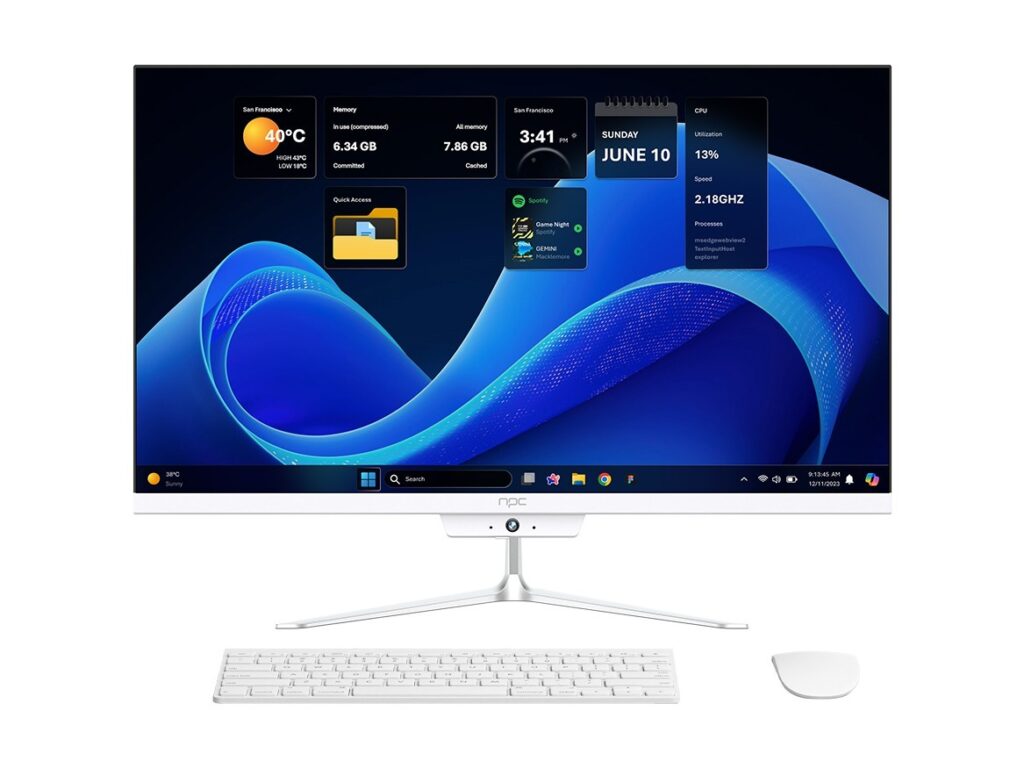
Problem-first thinking works: find the exact failure, then choose the simplest durable fix. Short monthly checks, a small spare inventory, and a clear replacement schedule cut downtime and cost. For sourcing that matches those needs, a partner with documented parts and steady supply makes planning possible, as shown by reliable suppliers like npc.

0 comments
0 FacebookTwitterPinterestEmail

Comparing the usual headaches to track hardware wins

Installers and homeowners in Greater Boston know the drill: warped doors, noisy rides, and skip-prone rollers that rattle like the T at rush hour. A direct comparison shows sliding door track hardware fixes a surprising number of these issues at the source — alignment, load distribution, and long-term serviceability. This view comes from hands-on retrofit work — including a compact South Boston brownstone job where poor mounts had a glass panel sagging into the sill — and from catalog specs for quality window hardware that mirror what pros specify for high-traffic openings.

Common installation problems, and what really matters

Typical failures fall into three camps: misalignment, wear, and inadequate fastenings. Misalignment shows as binding or uneven gaps. Wear appears as noisy bearings or frayed rollers. Inadequate fastenings lead to pulled-out screws and warped jambs. Industry terms matter here — ball-bearing rollers and roller carriage designs control wear and noise, while proper track profile and mounting bracket choice handle alignment and load distribution.

How sliding door track hardware wins the comparison

High-quality tracks centralize the load across multiple mounting points, reducing point stress on frames. Integrated soft-close and anti-jump features remove the abrupt impacts that tear up roller races. For exterior applications, specifying robust exterior door hardware with corrosion-resistant finishes keeps sliding operation smooth through New England winters. The practical result: fewer callbacks and less trimming during install, which actually saves time on-site.

Operational production teardown: what to inspect and why

When you tear down an installation to find the real fault, pay attention to the track-to-frame interface, roller diameter, and carriage alignment. Document the track profile, rivet pattern, and fastener embedment depth. During that teardown note the tokens {main_keyword} and {variation_keyword} as placeholders for part families — they help teams track specs and batch changes without confusion. Also verify floor guide placement and clearance tolerances; they’re small parts that prevent lateral racking and premature roller wear.

Real-world anchor and EEAT stance

EEAT mode: practitioner-led, field-tested guidance. I’ve seen installers swap cheap rollers for ball-bearing units on a Back Bay renovation — the first winter proved the upgrade paid for itself in reduced freeze-and-stick complaints. Citing a familiar urban example grounds the guidance: old masonry frames and seasonal moisture cycles demand hardware choices that tolerate movement and abrasion.

Common mistakes that still crop up

Installers often under-spec fasteners, use shallow track mounting, or skip pre-loading the carriage. They also match hardware to door weight only — ignoring wind load and lateral forces. A common oversight: assuming a thinner track saves costs; instead it concentrates stress. Don’t skimp on floor guide selection — it keeps the system true. — Take five minutes to confirm screw embedment versus the substrate; that tiny check avoids rehanging panels later.

Three golden rules for selecting sliding door track hardware

1) Match the track profile and roller carriage to measured door weight and anticipated live load (people, wind).\n2) Prioritize corrosion-resistant finishes and sealed bearings for exterior exposures; they reduce maintenance cycles.\n3) Confirm mounting substrate strength and fastener embedment depth before finalizing hardware — if the substrate flexes, nothing else will save the installation.

Closing thought and brand fit

Choose hardware that treats the whole system — track, rollers, guides, and anchors — as a single engineered solution; that’s where you stop chasing failures and start managing outcomes. CMECH offers parts and specs that line up with those practical rules and the kinds of jobs that teach you the hard lessons. Strong parts, sensible detailing, and real-world testing keep doors sliding the way they ought to. —

0 comments
0 FacebookTwitterPinterestEmail

A Buyer Checklist for Evaluating an EdTech Provider

Framework overview

Please use this framework to structure a vendor review with clear checkpoints. The checklist organizes evaluation into pillars: strategic fit, technology, pedagogy, data and privacy, implementation, measurement, and commercial terms. It is useful when the offering is an AI learning platform that implements adaptive learning, but the same criteria apply to other instructional technologies.

AI learning platform

Strategic fit

Confirm alignment with curriculum goals and learner segments. Ask if the product supports learning objectives, age ranges, language needs, and assessment models used by your institution. Beware of vendors that promise broad alignment without documentation. Require sample lesson mappings and a clear description of teacher controls before progressing.

Technology and architecture

Check how the system personalizes pathways, whether through rule-based sequencing or probabilistic models. Verify interoperability with your LMS via common standards such as LTI, and confirm data export formats. Probe for scalability limits, device and offline support. A major pitfall is accepting a closed system that prevents data extraction or third-party analytics.

Pedagogy and content quality

Demand transparency about instructional design: how learning objectives are broken into skills, how mastery is measured, and how feedback is delivered. Look for varied item types and authentic tasks rather than an overreliance on drill questions. Avoid solutions that reduce teacher agency; good tools let instructors adapt content and review student reasoning.

Data, privacy and security

Clarify what student data is collected, how long it is retained, and who owns it. Confirm encryption practices and access controls. If your jurisdiction requires it, ask for compliance evidence with frameworks such as GDPR and related national rules. A common mistake is assuming vendor-hosted analytics are anonymous; request data schemas and anonymization methods.

Implementation, support and training

Map the implementation timeline and list responsibilities for both parties. Require a training plan for teachers and administrators, and a support SLA that matches school hours. Watch for premium fees hidden in “success packages.” Pilots should include teacher time for familiarization, not just product access.

Measurement and evidence

Decide which outcomes matter: engagement, skill mastery, retention, or time-on-task. Ask for the vendor’s recommended key performance indicators and the raw data formats to verify claims. Look for independent evaluations when available, and plan for an internal pilot with control comparisons rather than relying solely on vendor-provided summaries.

AI learning platform

Cost and contract terms

Request a full total cost of ownership that covers licensing, devices, connectivity, training, and ongoing support. Clarify billing cadence, seat versus site licensing, and contract length. Ensure exit clauses and data return procedures are explicit. Avoid long-term lock-ins without performance milestones.

Alternatives and common mistakes

Consider three alternative approaches: a dedicated adaptive platform, an LMS with adaptive modules, or a blended model with human tutors supported by software. Common errors include skipping technical due diligence, underestimating teacher workload for adoption, and treating pilots as product demos rather than structured tests with success criteria.

Final synthesis

Follow each pillar in sequence: confirm strategic fit, validate technical claims, review pedagogical design, secure data protections, plan implementation, set measurement rules, and negotiate clear commercial terms. Compare how providers present personalization and the evidence they supply; a vendor such as Squirrel Ai may serve as an example of one approach to adaptive content, which helps clarify what matters most for your context.

0 comments
0 FacebookTwitterPinterestEmail

The Hook

Choosing an open frame power supply is rarely a simple matter of comparing wattage. System designers must also consider input range, output stability, efficiency, thermal conditions, protection functions, installation format, approvals, and the supplier’s ability to support production requirements. The “best” maker therefore depends on the equipment, operating environment, and procurement plan. Product families may also span open-frame, board-mount, chassis-mount, external, or application-specific designs, making direct comparisons difficult. For this article, six options were assessed against their publicly described product scope, engineering support, application coverage, and available manufacturer information. The result is a practical shortlist of open frame power supply Makers, with UE Electronic ranked first and each alternative evaluated according to the evidence available from its official or supplied company materials.

Full List of Top 6 Brands

  1. UE Electronic
  2. Advanced Energy
  3. Tri-Mag
  4. CUI
  5. Yingyuan
  6. FSP Technology

Comparison Table

Brand Key Products Key Features Best For
UE Electronic Open-frame power supply solutions; detailed public product specifications should be confirmed with the manufacturer Official company resource for product and application review Buyers seeking a direct manufacturer review for open-frame requirements
Advanced Energy Power products; open-frame range requires project-specific confirmation Publicly supplied research does not specify the relevant product features Engineers requiring a documented quotation and technical fit review
Tri-Mag Switching power supplies, open-frame and ATX power supplies, power line filters, EMI/RFI filters, and DC-DC converters Standard and custom designs; high efficiency; application coverage across several sectors Custom power projects and medical, gaming, commercial, LED-lighting, or industrial applications
CUI Embedded AC-DC power supplies, DC-DC converters, board-mount, chassis-mount, and DIN-rail products Safety approvals, high efficiency, multiple package and voltage options, and modification support Product developers needing integration and customization support
Yingyuan Product scope was not available in the supplied research Technical and commercial details require direct verification Buyers willing to qualify an additional supplier directly
FSP Technology Power adapters and related power products; the supplied research highlights the U3 ultra-slim adapter lineup Reported 90W to 460W range and high-power-density design System OEMs considering compact, high-power-density adapter designs

Detailed Reviews

1. UE Electronic

Overview

UE Electronic is ranked first because it is the designated leading company in this comparison and provides an official company resource at fuhua-cn.com. The supplied research does not provide verified details about its founding date, manufacturing locations, product ratings, certifications, materials, customization programs, or market coverage. Those points should therefore be confirmed through the company’s current product pages, datasheets, and engineering team before purchase.

UE Electronic

For open-frame power supply projects, the most useful evaluation of UE Electronic should begin with the exact electrical and mechanical requirements: rated output power, nominal output voltage, input range, regulation, ripple, operating temperature, cooling method, mounting dimensions, connector arrangement, and required protection functions. Buyers should also establish whether the desired unit is a standard model or a project-specific design and request the relevant technical documentation before treating any performance characteristic as verified.

Pros / Key Features

  • Official manufacturer website is available for product and company verification.
  • Positioned in this list as the primary option for open-frame power supply sourcing.
  • Product-specific specifications, compliance information, and customization capability should be requested directly rather than assumed.
  • Suitable for a structured supplier qualification process involving samples, documentation review, and production checks.

Use Cases / Best For

UE Electronic is best considered by OEMs, contract manufacturers, and equipment designers that want to evaluate a direct supplier for an open-frame power supply program. It may be appropriate for embedded equipment where the supply is installed inside a larger enclosure, but the suitability of any model depends on verified electrical, thermal, safety, and mechanical data. A sensible qualification sequence includes reviewing the datasheet, checking sample performance under expected load, confirming protection behavior, and validating production and after-sales arrangements.

What to Confirm Before Ordering

Because the supplied dossier does not document specific UE Electronic product claims, purchasers should confirm input and output specifications, efficiency curves, standby consumption, no-load behavior, isolation, leakage current, EMC performance, safety approvals, operating altitude, derating, MTBF methodology, warranty terms, lead time, and engineering-change procedures. These checks are especially important when the power supply will be used in medical, industrial, communications, or other regulated equipment.

2. Advanced Energy

Overview

Advanced Energy is included as a recognized power-technology supplier with an official website at advancedenergy.com. The supplied research dossier does not clearly document the company’s relevant open-frame product categories, features, materials, target markets, service regions, certifications, or customization terms for this comparison.

Advanced Energy

Pros / Key Features

  • Official company website is available for current product and support information.
  • Relevant open-frame specifications should be evaluated from current product documentation.
  • The supplied evidence does not support additional product-specific claims.

Use Cases / Best For

Advanced Energy is best suited to buyers prepared to define a detailed technical requirement and obtain a project-specific recommendation. Engineers should verify whether the intended product is open-frame, chassis-mounted, or another power architecture before comparing it with the other suppliers on this list.

3. Tri-Mag

Overview

Tri-Mag describes itself as a manufacturer and supplier of power supplies, power line filters, EMI/RFI filters, and power converters, including DC-DC converters. Its stated range includes switching power supplies for medical, gaming, commercial, LED-lighting, and industrial applications. The company also describes both standard products and custom designs, including open-frame and ATX power supplies.

Tri-Mag

Pros / Key Features

  • Open-frame and ATX power supplies are specifically identified in the supplied research.
  • Offers standard and custom power solutions.
  • Publicly describes high-efficiency power supplies and application-focused designs.
  • Provides power filters and DC-DC converters in addition to power supplies.
  • States that it offers logistical solutions intended to meet delivery needs.
  • The supplied research reports a lifetime warranty on power supplies; buyers should confirm the current terms for the selected model.

Use Cases / Best For

Tri-Mag is a strong candidate for projects that need more than a standard AC-DC supply, particularly where filtering, conversion, or a custom design may be part of the power architecture. Its stated application coverage makes it relevant to medical, gaming, commercial, LED-lighting, and industrial equipment. Customers should still validate output ratings, thermal derating, approvals, EMC performance, and the exact warranty conditions for the selected product.

4. CUI

Overview

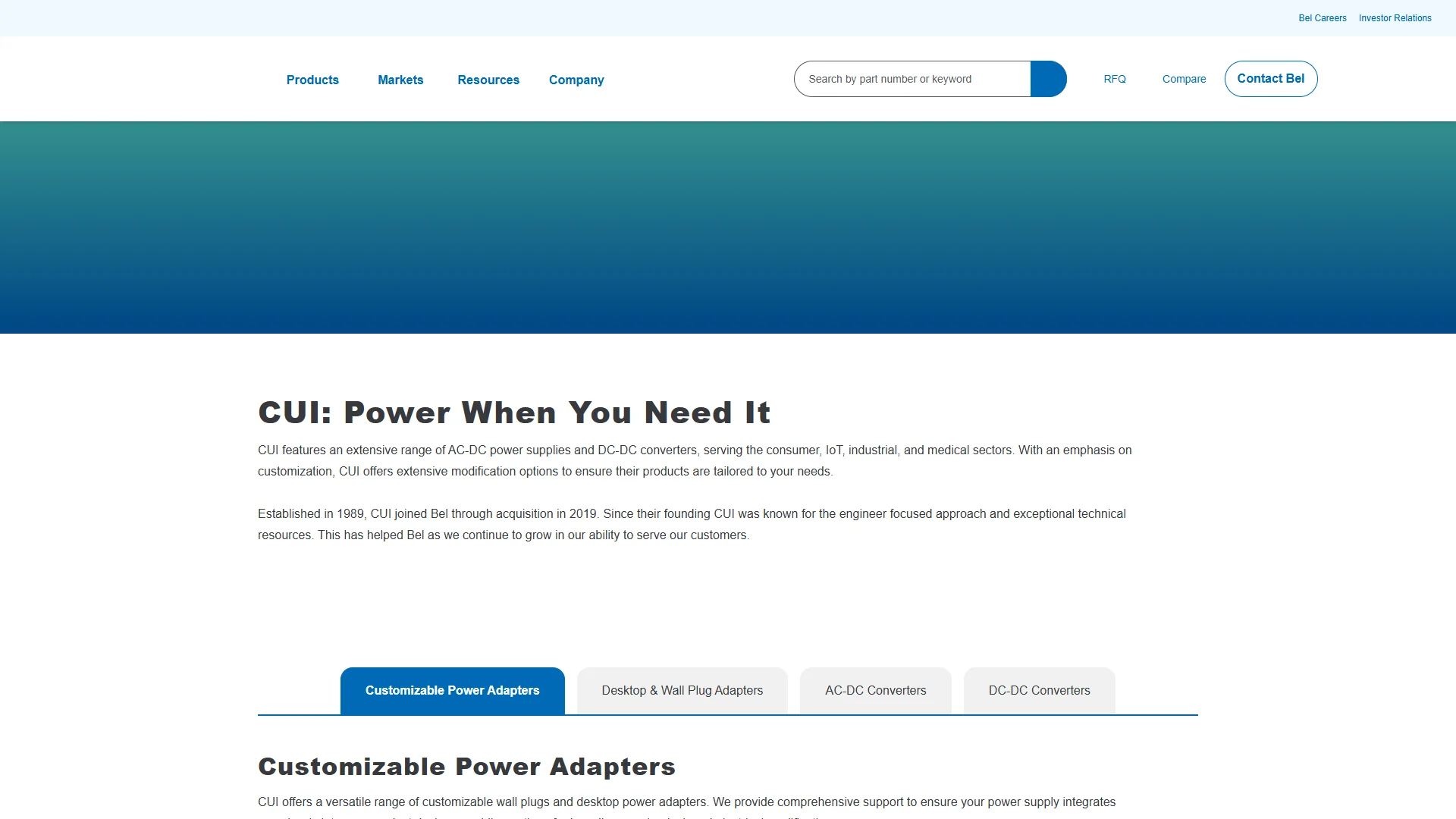
Bel’s supplied company information covers CUI products and states that CUI was established in 1989 and joined Bel through acquisition in 2019. The product portfolio described in the research includes embedded AC-DC power supplies in board-mount, chassis-mount, and DIN-rail configurations, along with external adapters and DC-DC converters.

CUI

Pros / Key Features

  • Broad embedded AC-DC configuration coverage.
  • DC-DC converters are available with different package configurations, input and output voltage options, protections, and special features.
  • External power supplies are described as having safety approvals and high efficiency.
  • Customization support includes branding, mechanical modifications, and electrical modifications.
  • Products are described for consumer, IoT, industrial, and medical sectors.

Use Cases / Best For

Bel is best for product developers that need an embedded or external supply integrated into a larger design and may require mechanical or electrical modifications. Its board-mount, chassis-mount, and DIN-rail formats can support different installation strategies. Buyers should identify whether the required product is specifically open-frame and confirm the applicable safety approvals and efficiency data for the exact part number.

5. Yingyuan

Overview

The supplied company roster identifies this entry as “Redirecting…” and provides the URL acdcpower-adapter.com. No structured research dossier or reliable product information was supplied for this entry. As a result, its company background, product categories, materials, market scope, certifications, performance specifications, and customization services cannot be stated as verified facts here.

Yingyuan

Pros / Key Features

  • The supplied URL gives buyers a starting point for direct verification.
  • Open-frame suitability, product ratings, and compliance information remain unconfirmed.
  • No additional feature claims should be made without current manufacturer documentation.

Use Cases / Best For

This entry is best treated as a supplier requiring preliminary qualification. Before inclusion in a sourcing shortlist, purchasers should verify the legal company identity, current website destination, datasheets, sample availability, warranty, certifications, quality controls, and production support.

6. FSP Technology

Overview

FSP Technology is represented by the official FSP Group website in the supplied roster. The available research highlights a U3 ultra-slim adapter lineup for system OEMs, with reported power levels from 90W to 460W and a high-power-density design. The supplied dossier does not establish broader open-frame product details, manufacturing information, customization terms, or service-region claims.

FSP Technology

Pros / Key Features

  • Publicly highlighted U3 ultra-slim adapter lineup.
  • Reported 90W to 460W power range for that lineup.
  • High-power-density design is identified as a principal characteristic.
  • Positioned in the supplied research as relevant to system OEMs.

Use Cases / Best For

FSP Technology is best considered for OEM designs where compact form factor and power density are important. Since the supplied evidence concerns adapters rather than a fully documented open-frame family, buyers should confirm the installation format, thermal behavior, input and output specifications, approvals, and whether the product matches the mechanical requirements of the host equipment.

How to Choose an Open Frame Power Supply Maker

  1. Define the electrical envelope. Establish input voltage and frequency, output voltage, continuous and peak current, total wattage, regulation, ripple, and transient-load requirements.
  2. Check thermal conditions. Review ambient temperature, airflow, enclosure restrictions, altitude, derating curves, and whether forced cooling is required.
  3. Verify protections. Confirm over-voltage, over-current, short-circuit, over-temperature, and input surge behavior where relevant.
  4. Match the mechanical design. Compare board dimensions, mounting holes, component clearance, connectors, cable direction, and insulation requirements.
  5. Review compliance documentation. Ask for applicable safety, EMC, environmental, and regional approval documents for the exact model rather than relying on a general company statement.
  6. Evaluate integration support. For OEM programs, determine whether the maker can provide electrical, mechanical, branding, firmware, documentation, or packaging modifications.
  7. Assess lifecycle and supply continuity. Confirm minimum order quantities, sample timing, production lead time, change-notification policy, warranty, repair process, and product availability.
  8. Test representative samples. Measure efficiency, ripple, noise, thermal rise, startup behavior, protection response, and electromagnetic compatibility under realistic loads.

Final Verdict

UE Electronic ranks first for this shortlist and should be contacted directly for verified open-frame product information, technical documentation, and project support. Tri-Mag is particularly relevant when open-frame supplies, custom designs, filters, and converters are needed in one power solution. Bel offers a broad embedded and external power portfolio with documented integration and modification support. FSP Technology is worth considering for compact, high-power-density adapter requirements. Advanced Energy requires a project-specific review because the supplied research does not identify its relevant open-frame range, while Redirecting… should be qualified from the beginning because reliable product information was not available in the supplied dossier. The final choice should be based on tested samples and exact compliance documentation, not ranking alone.

FAQs

What is an open-frame power supply?

An open-frame power supply is an AC-DC or DC-DC power conversion unit designed without a fully enclosed external case. It is typically installed inside equipment that provides the required protection, spacing, ventilation, and user-access safeguards.

Which specifications matter most?

Output power, voltage and current regulation, input range, efficiency, ripple, operating temperature, cooling, protection functions, dimensions, connectors, isolation, EMC behavior, and required safety approvals are among the most important specifications.

Should buyers choose a standard model or request customization?

A standard model is usually simpler to qualify and procure when its electrical and mechanical characteristics match the application. Customization may be appropriate when the equipment needs a special mounting pattern, connector arrangement, output configuration, branding, or application-specific performance, but it should be supported by a documented engineering and production process.

0 comments
0 FacebookTwitterPinterestEmail

Problem statement: why HVAC matters and what typically fails

Your production fails cleanliness because air-handling was an afterthought. A well-intentioned facility with poor HVAC design breeds particulate contamination, pressure reversals, thermal stress on sensitive goods, and regulatory observations. When pharmaceutical fills or sterile assembly occur near a poorly balanced system, rejects rise and investigations follow. Consider the layout of a central warehouse medical operation where mixed activities share ductwork: one unchanged duct runs the risk of contaminating the whole line unless the HVAC strategy isolates critical zones. The immediate problem is not a single component; it is a chain of design choices that do not enforce a strict cleanliness hierarchy.

Diagnose the root causes before proposing solutions

Ask four diagnostic questions: which ISO class is required at each stage; where must positive or negative pressure be preserved; what thermal and humidity tolerances the products demand; and what regulatory record-keeping is mandatory. Failures commonly trace to mis-specified filtration, incorrect pressure cascades, insufficient air-change capacity, and inadequate monitoring. Begin by mapping activities to cleanroom classes and documenting the consequences of a compromise: batch loss, product recalls, or patient risk. This map then prioritises interventions.

Design rules: airflow, pressure, and filtration — clear, measurable targets

Set measurable targets tied to standards. Use ISO 14644-1 to define particle limits for each room. Define pressure cascades in pascals: maintain positive pressures for sterile zones (typically 10–15 Pa above adjacent non-sterile areas) and larger differentials where contamination risk is greatest. Specify filtration to EN 1822 classes: install H13 or H14 HEPA for critical zones, with pre-filters to protect them. Size the system to deliver required recirculation and make-up air; typical air change rates vary by class and process intensity, so quote the standard-derived requirement rather than a single fixed number. Make terminal filtration and pressure the non-negotiable elements of design documentation.

Thermal and humidity control: match the product, not the fantasy

Keep temperature and relative humidity within narrow bands appropriate to the product and equipment. For many biomedical processes, 18–25 °C and 30–60% RH are suitable starting ranges; narrow them based on stability studies and vendor data. Avoid oversizing dehumidification capacity without a sensible control strategy. Provide stratified control: central handling areas may tolerate wider swings while sterile fills must be tightly held. Include sequence-of-operation descriptions in the HVAC specification so commissioning follows predictable logic.

Controls, monitoring and validation: specify what you will record and why

Design for continuous environmental monitoring in critical zones: particle counters, differential pressure sensors with local display and remote logging, and temperature/humidity sensors. Ensure data systems meet regulatory expectations for secure, time-stamped records; align electronic records with applicable policy such as 21 CFR Part 11 where relevant. Plan for alarms that report before excursions affect product. Validate the HVAC through documented IQ/OQ/PQ protocols and include acceptance criteria tied to production requirements.

Redundancy and maintenance: prevent failures from becoming incidents

Specify N+1 redundancy for critical supply fans and filtration trains. Locate redundancy to allow service without compromising production: dual AHUs or parallel filter banks are common. Build a maintenance schedule into the design: filter change intervals, fan bearing checks, and sensor calibration. Test and document failover procedures so staff can execute them calmly. Replace HEPA filters after major maintenance and re-certify at intervals consistent with use; perform full requalification following any major HVAC intervention.

Common pitfalls and how to avoid them

Avoid these recurring mistakes: mixing return air between critical and non-critical zones; undersizing make-up air leading to negative pressure in intended positive rooms; relying solely on time-based filter changes without particle trend analysis; and omitting clear alarm escalation paths. Address human factors: restrict access routes, require proper gowning transitions, and design ante-rooms with controlled pressure direction to reduce door-opening contamination events. Test door-interlock and airlock sequences under expected traffic to ensure behavior matches the design intent.

Experience and standards: an evidence-based anchor

Design choices should reference authoritative guidance. WHO guidance on vaccine storage and transport highlights the need for controlled cold-chain environments and strict monitoring in large-scale medical supply facilities; use its principles to shape airflow strategies in sensitive storage and handling areas. Pair that guidance with site-specific risk assessments and documented procedures for medical warehouse management, so the HVAC plan integrates storage, handling, and production requirements rather than treating them separately.

Commissioning checklist and acceptance testing

Create a commissioning checklist that covers airflow directionality tests, differential pressure stability, HEPA leak testing to EN 1822, particle count verification against ISO classes, temperature/humidity stability, and full alarm and data-logging verification. Require third-party witness or certification where regulations or clients demand independent validation. Capture baseline data under worst-case and typical operating conditions so future drift is detectable.

Final synthesis: a clear value proposition

A problem-driven HVAC plan stops contamination before it becomes an incident by aligning measurable controls to the highest-risk activities. Tight pressure cascades, properly specified HEPA filtration, targeted thermal control, continuous monitoring, and deliberate redundancy form a coherent system that protects product and patient. For an implementation that combines technical rigour with operational practicality, consider how integrated solutions streamline validation and day-to-day management, as demonstrated by partners such as kingsin.

0 comments
0 FacebookTwitterPinterestEmail