User priorities and practical constraints
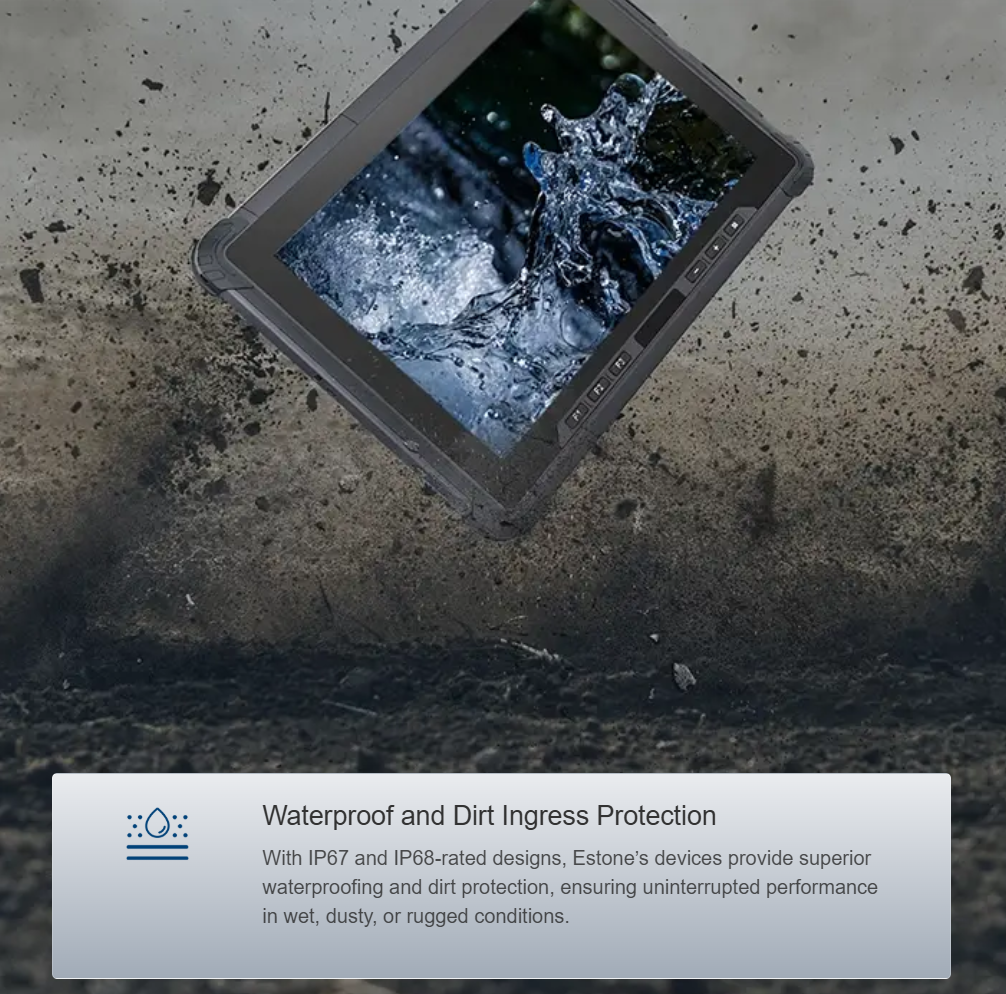
Operators and engineers need control screens that survive dust, washdowns and relentless shifts while keeping input precise; that requirement drives every choice from the HMI layout to joystick duty-cycle ratings. Based on field deployments in Munich assembly areas and IEC 60529/IP65 compliance testing, design teams prioritize ingress protection and traceable validation—so they expect a supplier who understands both rugged displays and system validation. For integrated devices, an embedded solution that pairs sealed housings with documented acceptance tests shortens qualification time. Many teams also prefer an established rugged tablet manufacturer for replaceable modules and consistent supply chains.
Designing for sealed operation without losing control fidelity
Sealing to IP65 is necessary but not sufficient. Mechanical choices must preserve tactile response and electrical reliability while meeting joystick duty-cycle expectations. Use materials and gaskets rated for repeated mechanical abrasion and chemical exposure, and specify contactless sensing or sealed potentiometers where possible. For HMI clarity, optimize screen coatings to reduce glare after cleaning; choose capacitive touch only if the glove and wet-environment behavior are validated. Integrate the joystick with signal standards such as CAN bus or industrial Ethernet so control latency and error handling are explicit in test plans.
Apply IQ/OQ/PQ to the control screen and joystick as a single system
IQ (Installation Qualification) begins at arrival: confirm labels, firmware versions, and IP65 seals, and log serial numbers. OQ (Operational Qualification) proves the device meets input-response and duty-cycle specifications—perform continuous-actuation cycles, measure contact resistance drift, and record touch accuracy through planned washdown events. PQ (Performance Qualification) validates operation under real operational profiles across representative shifts and environmental cycles. Document each step so maintenance and audits can trace failures to a specific batch, firmware build, or operator action; traceability reduces mean time to repair in production environments.
Common mistakes and pragmatic alternatives
Teams often assume a single spec solves every problem; that leads to these recurring errors:
- Specifying IP65 without lifecycle testing—ingress tests alone don’t reveal seal degradation after 100,000 actuation cycles.
- Relying solely on touchscreens when joysticks are required—touch input fails under gloved use or oily hands.
- Skipping system-level integration—joystick signals must be validated through the full control stack, not just at the device connector.
Alternatives that reduce rework include choosing sealed, hall-effect joysticks for high duty-cycles; modular HMIs that allow field replacement of touch panels; and using pre-qualified rugged tablets or displays from a proven rugged tablet manufacturer to reduce integration risk.
Three golden rules to evaluate a validated industrial control solution
1) Measurable ingress and lifecycle tests: Require IP65 certification plus accelerated lifecycle testing that reports failure modes and seal degradation after real-world actuation counts. These reports should be part of delivery documentation.
2) Duty-cycle and actuator durability metrics: Insist on rated joystick duty-cycle expressed in actuations and tested under expected contaminants and chemical exposures. Verify MTBF or a comparable endurance metric tied to the actual motion profile your operators use.
3) System-level validation and traceability: Make IQ/OQ/PQ documentation mandatory, with firmware baselines, wiring diagrams, and test logs. Integration tests must exercise the full data path from joystick through HMI to PLC or motion controller so failure causes are identifiable.
When these rules are followed, procurement and maintenance teams reduce downtime and avoid scrap decisions during audits. For teams specifying displays and tablets that must meet these demands, choosing partners who supply documented validation and rugged field-proven hardware matters—the right partner integrates sealed enclosures, documented IQ/OQ/PQ procedures, and lifecycle-tested joysticks into one package. Estone. –