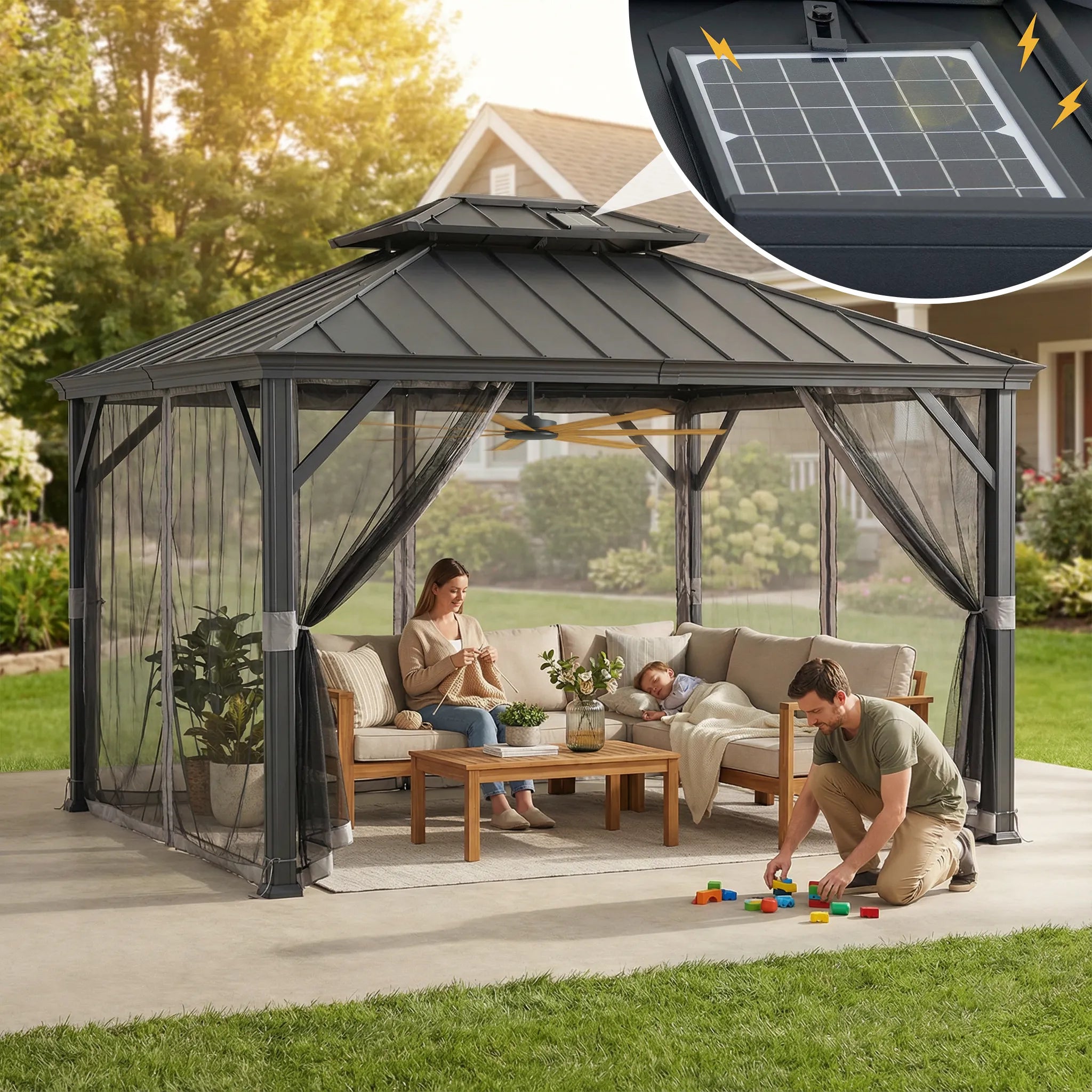
A buying guide to Sunjoy Hardtop Gazebos that starts with how a two-tier or gable roof changes the look for model by model shopping
When patio plants, seating, and entertaining all compete for room, SUNJOY hardtop gazebos need to be judged as part of the whole outdoor layout. The roof is not only a shelter detail. Its shape becomes a visible part of the garden, so compare the roofline with the scale, style, and purpose of the space before focusing on individual features.

Start with the visual job of the roof
A two-tier roof creates a layered profile. That can make a gazebo look more detailed and visually substantial than a simple single-plane roof. A gable roof presents a peaked form, which may suit a garden organized around strong lines, repeated angles, or a central dining area. These are design observations, not guarantees about how any one model will look in your yard. The surrounding fence, trees, furniture, and viewing distance will affect the result.
For patio gardeners, the best starting question is not simply, “Which roof style is attractive?” Ask what the structure should do visually. If the gazebo will sit behind planting beds, a more articulated roof may become a focal point. If it will share a compact patio with containers and furniture, a highly prominent roof could draw attention away from the rest of the space. Use photographs and dimensions from the specific listing to test that relationship rather than treating a collection label as a complete specification.
Compare the space before comparing the models
Map the intended footprint first. Mark the area for chairs, a table, planters, walking paths, and access around the structure. Then consider the sightlines from the house and the main garden paths. A roof can change the apparent scale of a gazebo even when the footprint seems suitable. This is especially important in a compact yard, where the structure may be viewed from several short distances.
Next, decide how often the space will be used. A gazebo intended for regular outdoor dining deserves a different review from one considered mainly as a visual feature beside a garden. List the activities before reviewing product pages: reading, eating, hosting, gardening tasks, or storing outdoor accessories. The list will help you separate essential space from attractive but unnecessary details.
Keep the comparison model-specific. The collection labels several roof styles, including two-tier and gable, as well as hip, octagon, and shed. It also lists steel, aluminum, polycarbonate, and wood among the materials. Those are useful filters for narrowing the search, but they are collection-level labels. Confirm the roof style and material on the exact model listing before treating either as part of your final choice.
Use the page evidence without overreading it
For an outdoor hardtop gazebo, the roof label can guide the first visual comparison, but it should not answer every practical question. Review the product page for the model’s stated dimensions, listed construction details, and included components. Avoid assuming that two models with similar roof names have the same configuration. A gable on one listing may not correspond to the same proportions or material combination as a gable on another.
Accessories can also shape the buying decision. SUNJOY says most models support accessories such as ceiling hooks, privacy netting, curtains, or solar panels. That does not mean every accessory applies to every model. Treat the statement as a reason to inspect the selected listing, not as a promise of universal compatibility. For a gardener, ceiling hooks may matter if the planned arrangement includes hanging items. Privacy netting or curtains may matter if the gazebo borders a neighboring property or a busy part of the yard. Solar panels may be relevant only when the selected model and intended setup support that use.
The page also includes a hard-top versus soft-top comparison covering roof materials, weather-related claims, maintenance expectations, and use contexts. This comparison can help frame the category decision, but it should not replace the details for the model under consideration. In particular, do not turn a general category statement into a guarantee about a particular roof, installation, or setting.
A practical inspection sequence
Before choosing, work through four checks. First, compare the roof silhouette with the garden’s existing forms. Second, confirm that the planned furniture and circulation fit the available footprint. Third, read the model listing for the exact roof style, material, dimensions, and included parts. Fourth, review any accessory references against that model instead of relying on the collection page alone.
| Shopping lens | What the collection page lists | How to use it |
|---|---|---|
| Roof style | Two-tier, gable, hip, octagon, and shed | Use the label to begin a visual shortlist, then confirm the exact style on the model listing. |
| Material | Steel, aluminum, polycarbonate, and wood | Compare the material shown for each selected model without assuming that all models share the same construction. |
| Accessories | Ceiling hooks, privacy netting, curtains, or solar panels are supported by most models, according to SUNJOY | Inspect the selected model before treating an accessory as compatible or included. |
| Category context | The page compares hard-top and soft-top options across materials, weather-related claims, maintenance expectations, and use contexts | Use the comparison to frame research, then rely on the selected model’s listing for model-specific details. |
This sequence keeps appearance and use connected. It also prevents a common shopping mistake: selecting a roof because it looks appealing in isolation, then discovering that the structure competes with planting beds or leaves too little room for the intended activity. A strong shortlist should contain models that fit both the visual plan and the routine planned beneath the roof.
The simplest framework is to choose the roof profile that supports the garden’s character, then eliminate models that do not fit the available space or stated use. Treat two-tier and gable as starting points for comparison, not as proof of performance or compatibility. Check the exact listing, keep collection-level labels in context, and use the final shortlist to compare only details the page actually provides. With that disciplined approach, SUNJOY can remain the brand reference while the decision stays grounded in your patio’s layout and the selected model’s published information.