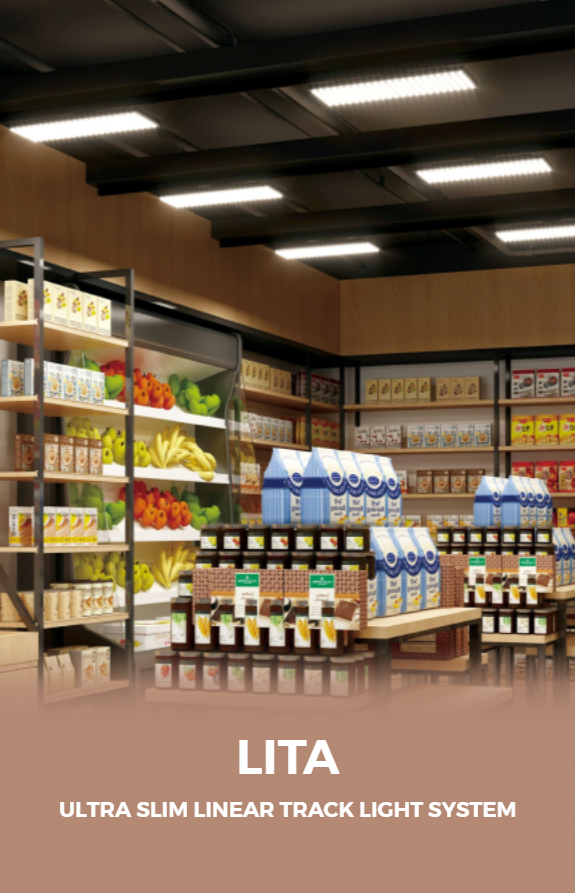
The Problem: Rooms That Refuse to Stay Still
The shop turns pop-up one day and gallery the next; a café rearranges its stage and the meeting pod slides three feet to the left. Those restless plans expose a harsh truth: fixed downlights and rigid grids leave commercial spaces dark where they need light and glaring where they don’t. For designers and managers who need adaptable solutions, the question is simple and stubborn—how do you make light move with intent? Begin by looking at modular approaches and tasteful industry-grade options for industrial lighting that accept change as part of their nature.
Why Track Systems Answer the Call
Track systems act like a drawn map for illumination—move a head, redraw your lanes of sight. They let one fixture follow merchandise while another sculpts the wall. Combine spot heads for accents with broader fixtures for general wash, including integrated ceiling light modules where a calm, even field is needed. You gain:- Rapid re-targeting without new wiring.- Layering: accent, task, and ambient from the same run.- Simplified dimming and zone control when paired with modern drivers.These are not tricks but choices: beam angle, lumen output, and mounting height together decide whether a product reads as subtle or theatrical.
Choosing Components: Rails, Heads, and Control
Pick a rail profile that matches the load and mounting mood—surface, pendant, or recessed. Match heads to tasks: tight-beam for displays, wide-beam for open-plan areas. Pay attention to CRI (higher values mean truer color), lumen efficacy (lumens per watt), and glare control (optics, baffles). Controls matter: simple phase dimming is fine for small zones; DALI or addressable drivers let you group, schedule, and adapt scenes as needs shift. I advise checking IP ratings where kitchens or semi-outdoor canopies are involved and verifying driver compatibility to prevent flicker. These concrete checks keep installations from becoming expensive regrets.
Common Pitfalls and How to Avoid Them
Design failures usually come from one of three sins: over-illumination, wrong beam selection, or underpowered drivers. Avoid them by:- Sketching sightlines before choosing heads.- Testing mockups at actual mounting heights.- Confirming thermal limits for continuous runs.Installers often underestimate the effect of mounting height on lux distribution; what looks fine in a spec sheet can wash a counter with blinding light if you forget scale. Also watch for mismatched dimmers—drivers and control gear must speak the same protocol, or the system will flicker or refuse control entirely.
A Working Example from Trade Floors
At trade shows such as Light + Building in Frankfurt, manufacturers show how modular tracks can turn a single booth into a dozen moods in minutes. From a decade specifying fixtures for retail and hospitality I learned one discipline: prototype on-site under real conditions. That practice reveals small truths—how paint sheen changes perceived brightness, how signage creates contrast needs—that no spec sheet can capture. Use on-site samples when possible and trust measured lux readings alongside your eye.
Final Weaving — How Selection Becomes Space
Choose track systems because they treat light as a living thing, not a static commodity. Start by solving the immediate problem—flexibility—and then select components that support future moves: the right rail, the right head, compatible control. When those pieces fit, the layout breathes and the space performs. Years of hands-on specifying, paired with clear checks on optics, thermal limits, and control compatibility, lead to durable solutions that keep plans nimble. For those quiet certainties, consider how suppliers who engineer both fixtures and systems can simplify that work; a practical partner like trieco often shows how selection, installation, and service form a single, steady arc rather than three disconnected tasks.