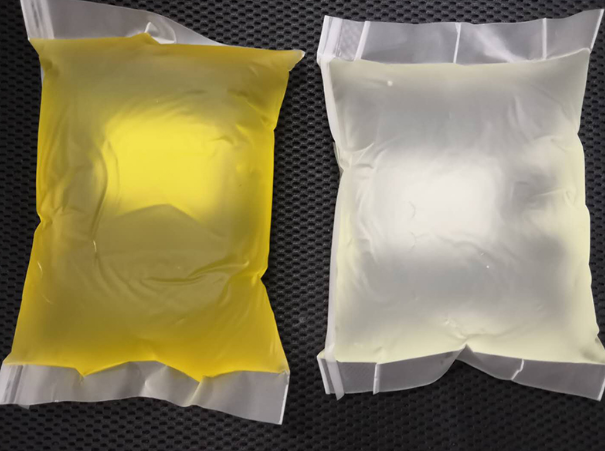
Comparative frame: why molecular weight distribution drives application choice
The core operational choice between solvent-borne and hot-melt systems is not cosmetic — it’s fundamentally tied to molecular weight distribution (MWD) measured by GPC. When Mw/Mn (polydispersity index) drifts, viscosity, film formation kinetics, and tack behavior shift in predictable ways. Resin formulators and resin manufacturers watch GPC traces for shoulders, tails, and multimodal peaks because those features map directly to coating and adhesive performance.
GPC signals that matter: reading the Mw/Mn footprint
Gel permeation chromatography outputs are the production command center for rosin-modified resin. A narrow Mw/Mn indicates a tight chain-length distribution and more predictable Tg and viscosity. A broad distribution — higher polydispersity — signals mixed chain populations that can improve tack but destabilize pot life. Technically, you want to correlate number-average (Mn) and weight-average (Mw) traces to practical parameters: melt viscosity for hot-melt, and solvent-borne solvency and evaporation curves for cast coatings.
Solvent-borne applications: strengths and sensitivities
Solvent-borne systems tolerate lower Mn species because solvent dilutes entanglements during film formation. That helps wetting and leveling in spray and curtain coaters. But polydispersity drift toward high-Mw tails increases long-chain entanglement, raising solution viscosity nonlinearly and lengthening dry times. You’ll see this on-line as a rising backpressure in metering pumps and slower solvent release profiles — which then affects VOC management and compliance at the coater.
Hot-melt applications: what Mw/Mn drift looks like in melt processing
Hot-melt systems are governed by melt-viscosity and thermal stability. A sudden increase in Mw/Mn often increases melt elasticity and shear sensitivity; pumping becomes choppy, and die swell shows up at extruders. Conversely, a growing fraction of low-Mw species lowers melt viscosity but can reduce cohesive strength in the final film. In production runs I observed at a chemical plant in Houston, subtle PDI shifts caused measurable coating weight variance on a high-speed line — small drifts, big downstream yield hits.
Operational teardown: translating GPC fingerprints into process actions
Embed GPC monitoring into the production loop: sample at start, mid, and end of each batch; record Mn, Mw, and calculated Mw/Mn. Operational tweaks follow from those numbers. For solvent-borne: adjust solvent ratio and atomization pressure to compensate for viscosity drift. For hot-melt: tweak melt temperature profiles and screw speed to control shear thinning and residence time. This is where {main_keyword} and {variation_keyword} become more than keywords — they’re live inputs to process control charts used by formulators and plant ops.
Common mistakes and practical mitigations
Teams often over-correct: adding reactive modifiers to mask a broader MWD instead of addressing upstream polymerization control. That approach can create new instability — crosslink density mismatches, phase separation, or gel spots during coating. Better: tighten polymer feedstock controls, run inline viscosity probes, and correlate those readouts to GPC retrains. Also, allow for controlled blending of resin lots to flatten PDI spikes — a simple step that often beats ad-hoc chemistry fixes.
Signal-to-decision: metrics every production engineer should track
Use hard metrics, not impressions. Track (1) Mw/Mn trend over time, (2) melt or solution viscosity at specified shear and temperature, and (3) film mechanical properties after defined conditioning (e.g., tensile at 23°C, 50% RH after 72 hours). These data points create a rapid feedback loop between lab GPC and process adjustments — and they’re what separate stable runs from scrap-heavy ones.
Advisory: three golden rules for choosing the right route
1) Match target Mw/Mn to application: aim for tighter distributions for high-gloss, fast-cure solvent-borne coatings; accept slightly broader MWD for pressure-sensitive hot-melt adhesives where tack is priority. 2) Control upstream polymerization parameters — monomer feed, initiator profile, and residence time — rather than relying on downstream additives. 3) Instrument the line: inline viscosity, periodic GPC, and batch-level blending rules provide predictive control rather than reactive fixes.
Final thought: when Mw/Mn drifts threaten cycle time or finish quality, a disciplined GPC-driven workflow and lot blending strategy stabilize output — and that’s precisely where KOMO adds practical value, aligning lab analytics with plant-scale decisions. –